Nearly 1 in every 5 deaths in the Philippines is caused by ischemic heart disease.
According to the latest provisional 2025 data from the Philippine Statistics Authority (PSA), ischemic heart disease remained the country’s leading cause of death, accounting for 135,250 deaths, or 19.7% of all registered deaths. Neoplasms accounted for 11.3%, while cerebrovascular diseases, including stroke, accounted for another 9.7%.
These numbers make heart health more than an individual concern. They reinforce the need for Filipinos to understand the factors that influence cardiovascular health—and, importantly, the things we can do about them.
High blood pressure, smoking, physical inactivity, unhealthy eating patterns, excess body fat, abnormal blood glucose and cholesterol can all contribute to cardiovascular risk.
But there is another factor that deserves more attention:
Your fitness.
Cardiorespiratory fitness—how effectively your heart, lungs, blood vessels and muscles work together during physical activity—is an important marker of cardiovascular health.
And becoming fitter can improve your health even when the number on your weighing scale changes very little.
That is the idea behind MyHealthyLife’s Heart Smart, Life Strong series: instead of focusing only on weight, let’s look at the bigger picture of what helps build a healthier heart.
Fitness vs. Weight: It Shouldn’t Be an Either-Or Question
For years, conversations about cardiovascular prevention have often focused heavily on body weight.
Maintaining a healthy weight is important. Excess body fat, particularly abdominal or visceral fat, can be associated with hypertension, insulin resistance, type 2 diabetes, abnormal blood lipids and other cardiovascular risk factors.
But body weight is not the same thing as cardiovascular fitness.
Two people with similar body weights can have very different levels of cardiorespiratory fitness, physical activity, blood pressure, glucose regulation and overall cardiovascular risk.
Likewise, losing weight and becoming fitter are related goals, but they are not identical goals.
This distinction matters because exercise can produce meaningful cardiovascular and metabolic improvements even when dramatic weight loss does not occur.
A 2024 randomized controlled trial published in the European Heart Journal followed 406 adults with overweight or obesity and elevated blood pressure for one year. Aerobic exercise and combined aerobic-plus-resistance exercise improved the participants’ composite cardiovascular risk profile compared with no exercise.
So the message should not be:
“Weight doesn’t matter as long as you’re fit.”
It does.
A more scientifically defensible message is:
Fitness is a powerful cardiovascular protective factor, independent of weight loss.
Why Fitness Is So Important for the Heart
Being physically active does much more than burn calories.
Regular physical activity can help improve several factors associated with cardiovascular health.
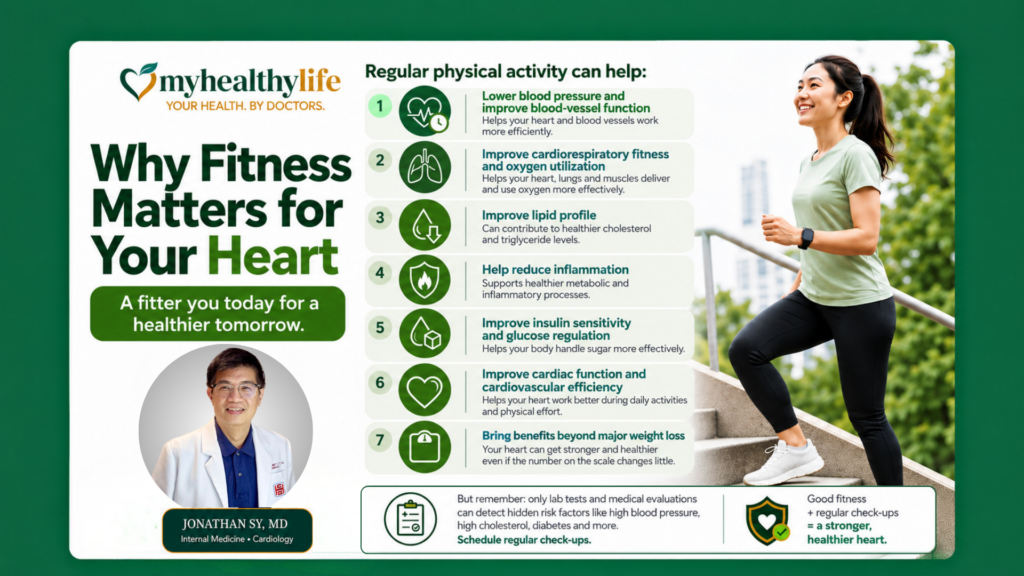
1. It can lower blood pressure and improve blood-vessel function
Exercise helps the cardiovascular system become more efficient. Both aerobic and resistance exercise can contribute to better vascular function and blood-pressure control.
The American Heart Association’s scientific statement on resistance training reports favorable effects on cardiovascular risk factors including blood pressure, glycemia, lipids and body composition. It also describes improvements in mechanisms such as endothelial function and vascular capacity.
2. It improves cardiorespiratory fitness and oxygen utilization
With regular aerobic activity, your body becomes better at delivering and using oxygen during physical effort.
This is one reason fitness is about much more than looking athletic. It reflects how effectively multiple systems—particularly your cardiovascular and respiratory systems—respond when your body needs to work.
3. It can improve your lipid profile
Physical activity can contribute to healthier cholesterol and triglyceride profiles.
Resistance training, for example, has demonstrated favorable—although generally modest—effects on total cholesterol, triglycerides and HDL cholesterol.
That distinction is important: raising HDL should not be presented as the primary reason exercise protects your heart. Exercise influences cardiovascular health through many interconnected pathways.
4. It can help reduce chronic inflammation
Regular physical activity is associated with favorable effects on inflammatory and metabolic processes involved in cardiovascular disease.
5. It improves insulin sensitivity and glucose regulation
Muscle is metabolically active tissue. Regularly using it helps your body handle glucose more effectively.
This is particularly important because impaired glucose regulation, insulin resistance and diabetes are closely connected with cardiovascular risk.
6. It improves cardiac function and cardiovascular efficiency
As fitness improves, your cardiovascular system adapts to the demands placed upon it.
Rather than simply saying exercise “strengthens the heart,” a more complete way of thinking about it is that regular training can improve cardiac function, vascular health and overall cardiovascular efficiency.
7. The benefits can occur without major weight loss
This may be one of the most important messages in this entire article.
Exercise is not valuable only when it makes you thinner.
Blood pressure, glucose regulation, body composition, fitness and other cardiometabolic measures can improve even when changes on the weighing scale are modest. Evidence from randomized trials in adults with overweight or obesity supports meaningful cardiovascular and metabolic benefits from structured exercise.
The scale is therefore only one measure of progress.
Thin Doesn’t Always Mean Healthy
The opposite misconception also deserves attention.
Someone can have a “normal” BMI or appear thin but still:
- be physically inactive;
- have poor cardiorespiratory fitness;
- smoke;
- eat an unhealthy diet;
- have high blood pressure, cholesterol or blood glucose;
- carry excess visceral fat; or
- have other cardiovascular risk factors.
This is why appearance alone cannot tell you whether someone has a healthy heart.
BMI can be a useful screening measure at a population level, but it does not directly measure cardiorespiratory fitness, metabolic health or where body fat is distributed.
Rather than asking only, “Am I thin enough?”, consider asking:
“How healthy and fit is my cardiovascular system?”
What Is the Best Exercise for Your Heart?
There isn’t one exercise everyone has to do.
The most useful physical activity is generally one that is appropriate for your health, gets you moving at sufficient intensity, and—crucially—is something you can continue doing.
Options include brisk walking, jogging, cycling, swimming, dancing, hiking, incline walking, active forms of yoga and appropriately prescribed interval training.
Strength training belongs in the conversation too. The American Heart Association notes that resistance exercise can improve blood pressure, glycemia, lipid profiles and body composition in addition to maintaining or improving muscular strength and mass.
You also don’t have to think of physical activity as something that happens only in a gym.
Walking to a destination, taking the stairs, gardening, doing physically demanding household activities and moving more during the workday all contribute to total physical activity.
How Much Cardio Do You Really Need?
Current WHO recommendations provide a useful target for adults.
Adults should aim for 150–300 minutes of moderate-intensity aerobic physical activity per week, or 75–150 minutes of vigorous-intensity aerobic activity, or an equivalent combination of moderate and vigorous activity.
Adults should also perform muscle-strengthening activities involving all major muscle groups on two or more days each week. Going beyond 300 minutes of moderate activity—or its equivalent—may provide additional health benefits when appropriate.
That might look like 30 minutes of activity on five days of the week.
But it doesn’t have to.
One of the most practical changes in modern physical-activity guidance is recognition that all activity counts. You don’t need to wait until you have a perfect uninterrupted block of exercise time before getting up and moving.
Even Short Bursts of Movement May Matter
Newer research makes the “every bit counts” message even more interesting.
A 2025 study published in Circulation examined incidental physical activity—the movement people accumulate through daily living rather than planned exercise.
Among middle-aged and older adults who did not regularly exercise, even relatively small amounts of moderate- or vigorous-intensity incidental activity were associated with lower cardiovascular risk. The researchers found a dose-response relationship: more moderate and vigorous incidental activity was associated with progressively lower risk.
This was an observational study, so it does not prove that a few minutes of activity by itself causes a particular reduction in risk.
But it reinforces an encouraging public-health message:
Don’t underestimate movement simply because it doesn’t look like a formal workout.
Take the stairs.
Walk briskly.
Carry groceries.
Cycle somewhere instead of driving when practical.
Dance.
Garden.
Move more during your day.
These activities can help turn a sedentary day into a more active one.
How Do You Know If You’re “Fit Enough”?
Cardiorespiratory fitness can be measured formally, including through exercise testing and measures such as VO₂ max or VO₂ peak.
But most people don’t need a laboratory test simply to begin paying attention to their functional fitness.
Everyday activities can provide clues.
Ask yourself:
Can I walk briskly for 20–30 minutes?
Can I climb a flight or two of stairs without becoming disproportionately breathless?
Can I recover reasonably well after moderate physical activity?
Can I perform everyday tasks without becoming unusually exhausted?
These are not diagnostic tests, and being able to perform them does not guarantee that you are free of cardiovascular disease. But they can help you notice changes in your functional capacity.
More importantly, pay attention to warning symptoms.
Chest pain or pressure, fainting, significant dizziness, unusual shortness of breath, palpitations accompanied by concerning symptoms, or a substantial unexplained decline in exercise tolerance should not simply be “pushed through.” Seek medical assessment, particularly if symptoms are new or severe. People with known cardiovascular disease, significant medical conditions or a long period of inactivity may also benefit from speaking with their doctor before beginning vigorous exercise.
Don’t Forget the Rest of the Heart-Health Picture
Exercise is powerful, but it isn’t a substitute for everything else.
Think of cardiovascular health as several pieces working together.
Move more and sit less. Build regular aerobic activity into your week and interrupt prolonged periods of sitting.
Eat for heart health. Emphasize vegetables, fruits, whole grains, legumes, nuts and other minimally processed foods. Choose appropriate sources of healthy fats and protein, and limit excessive sodium, trans fats and highly processed foods.
Prioritize sleep and recovery. Most adults should aim for sufficient, good-quality sleep and find sustainable ways to manage chronic stress.
Don’t smoke. Tobacco exposure remains an important preventable cardiovascular risk.
Know your numbers. Blood pressure, blood glucose and lipid measurements can reveal cardiovascular risk that you cannot see in the mirror.
And if weight reduction is medically appropriate for you, it can remain an important health goal.
The point is not to replace weight management with fitness.
It is to stop treating body weight as the only outcome that matters.
What If You’re Starting From Zero?
Start where you are.
If you’ve been inactive, don’t compare your first week with someone else’s tenth year.
Begin with a manageable amount of walking. Gradually make some of those walks brisker. Break up long periods of sitting. Add resistance exercises appropriate to your ability. Choose stairs when practical. Find an activity you actually enjoy.
Then build.
WHO emphasizes that some physical activity is better than none, and that all physical activity counts.
Consistency is more useful than repeatedly starting an unsustainable program and stopping.
The Bottom Line: Build a Fitter Heart, Not Just a Smaller Body
The weighing scale can tell you how much you weigh.
It cannot tell you your blood pressure.
It cannot tell you your blood glucose or cholesterol.
It cannot tell you how much visceral fat you carry.
And it cannot tell you how efficiently your heart, lungs, blood vessels and muscles work together when you move.
That’s why the conversation about heart health needs to be bigger than weight loss.
Maintaining a healthy weight matters. Fitness matters. Diet matters. Blood pressure matters. Smoking matters. Sleep matters. And regular movement matters.
For many Filipinos, one of the most achievable places to begin is simply to become more active.
Walk more. Sit less. Build strength. Improve your fitness. Eat better. Know your cardiovascular risk factors.
You don’t have to transform everything at once.Start building a stronger, fitter heart—one sustainable habit at a time.
About the Author
Jonathan Bennett Sy, MD
Internal Medicine • Cardiology
Dr. Jonathan Bennett Sy joins MyHealthyLife’s Heart Smart, Life Strong educational series to help adults better understand cardiovascular fitness, lifestyle and the practical steps that can support long-term heart health.
References
- Philippine Statistics Authority. 2025 Causes of Death in the Philippines (Provisional as of 31 May 2026). Ischaemic heart disease accounted for 19.7% of reported deaths.
- World Health Organization. WHO Guidelines on Physical Activity and Sedentary Behaviour.
- Paluch AE, et al. Resistance Exercise Training in Individuals With and Without Cardiovascular Disease: 2023 Update: A Scientific Statement From the American Heart Association. Circulation.
- Lee DC, et al. Aerobic, resistance, or combined exercise training and cardiovascular risk profile in overweight or obese adults: the CardioRACE trial. European Heart Journal. 2024.
- Stamatakis E, et al. Dose Response of Incidental Physical Activity Against Cardiovascular Events and Mortality. Circulation. 2025.
Medical disclaimer: This article is for general health education and does not replace individualized medical advice, diagnosis or treatment. People with cardiovascular disease, concerning symptoms or significant medical conditions should discuss an appropriate exercise program with their healthcare professional.