⏳Turning 40 feels like a magic switch flips:
Your favorite jeans suddenly feel tighter.
Weight creeps in—even if your routine hasn’t changed.
And everyone keeps saying, “Well, that’s just age.”
But is a slow metabolism after 40 really a fact of life—or just another myth that makes us give up before we try?
Let’s separate fiction from facts—and show you how to keep your metabolism firing, no matter your age.
What Is Metabolism, Really?
“Metabolism” is often misunderstood. It’s not just about burning calories. It’s the entire chemical process your body uses to convert food into energy.
Your basal metabolic rate (BMR)—the number of calories your body burns at rest—is the main part of that. It keeps your heart beating, lungs breathing, and brain thinking, even if you’re just chilling on the couch.
The faster your BMR, the more energy you burn doing… nothing. But it doesn’t stay static forever.
So, Does Metabolism Really Slow Down After 40?
✅ Yes, but it’s not as dramatic as you think.
Research shows that metabolic rate does gradually slow with age, but the real shift doesn’t typically happen until your 60s. So why do people gain weight in their 40s?
Here’s what’s really happening:
- Muscle mass starts declining in your 30s unless you actively work to maintain it. Less muscle = lower calorie burn.
- Activity levels often dip—thanks to office jobs, parenting, or just not having the same energy.
- Hormonal shifts (like lower estrogen or testosterone) can affect how your body stores fat or uses energy.
- Insulin sensitivity decreases, which can lead to more fat storage—especially around the belly.
- Thyroid function may dip, especially in women, affecting metabolic rate.
So it’s not that your metabolism “breaks”—it just needs more intentional support.
5 Reasons Your Metabolism Might Be Slowing (and What to Do)
1. You’re Losing Muscle Mass (Sarcopenia)
After 30, you can lose up to 5% of your muscle per decade. And muscle is your metabolic engine.
Fix it:
- Lift weights 2–3x/week. Even bodyweight squats or resistance bands help.
- Eat protein-rich meals (fish, chicken, tofu, legumes).
- Prioritize sleep—muscle repair happens while you rest.
2. Insulin Isn’t Working As Efficiently
As we age, our cells may respond less to insulin, a hormone that helps move sugar from your blood into cells. The result? Blood sugar spikes and more fat storage.
Fix it:
- Choose complex carbs (brown rice, quinoa, vegetables) over refined sugar.
- Stay active after meals—walking helps blunt sugar spikes.
- Manage stress, which can raise blood sugar on its own.
3. Thyroid Slowdown
Your thyroid gland controls your metabolic rate. Low thyroid hormone levels can lead to weight gain, fatigue, and cold intolerance.
Fix it:
- Get your TSH, T3, and T4 levels checked if you’re gaining weight with no explanation.
- Eat iodine-rich foods (seaweed, eggs, iodized salt) and selenium (Brazil nuts, tuna).
- Ask your doctor about thyroid function—especially if you also have low energy or dry skin.
4. Your Hormones Are in Transition
Estrogen (in women) and testosterone (in men) naturally decline with age. This can lead to more fat, less muscle, and slower metabolism.
Fix it:
- Consider strength training and healthy fats (like avocados and nuts) to support hormone balance.
- Talk to your doctor about hormone levels if you’re experiencing low libido, poor sleep, or stubborn weight gain.
5. You’re Less Active Than You Think
Many adults overestimate their activity. But sitting at a desk all day—even with a 30-minute workout—still counts as sedentary.
Fix it:
- Track your steps. Aim for 7,000–10,000 daily.
- Add “movement snacks” throughout the day—stretch breaks, standing meetings, post-meal walks.
- Don’t rely solely on cardio. Resistance training is a must for your metabolism.
Real Talk: Are Weight Loss Pills the Answer?
There’s no magic pill—but medical support is evolving. GLP-1 agonists, for example, are helping people manage weight and blood sugar, especially when insulin resistance is at play.
Still, these aren’t for everyone—and they work best with lifestyle changes.
✅ Bottom line: Even if your BMR drops slightly, it’s lifestyle—not just age—that has the biggest impact on your metabolism after 40.
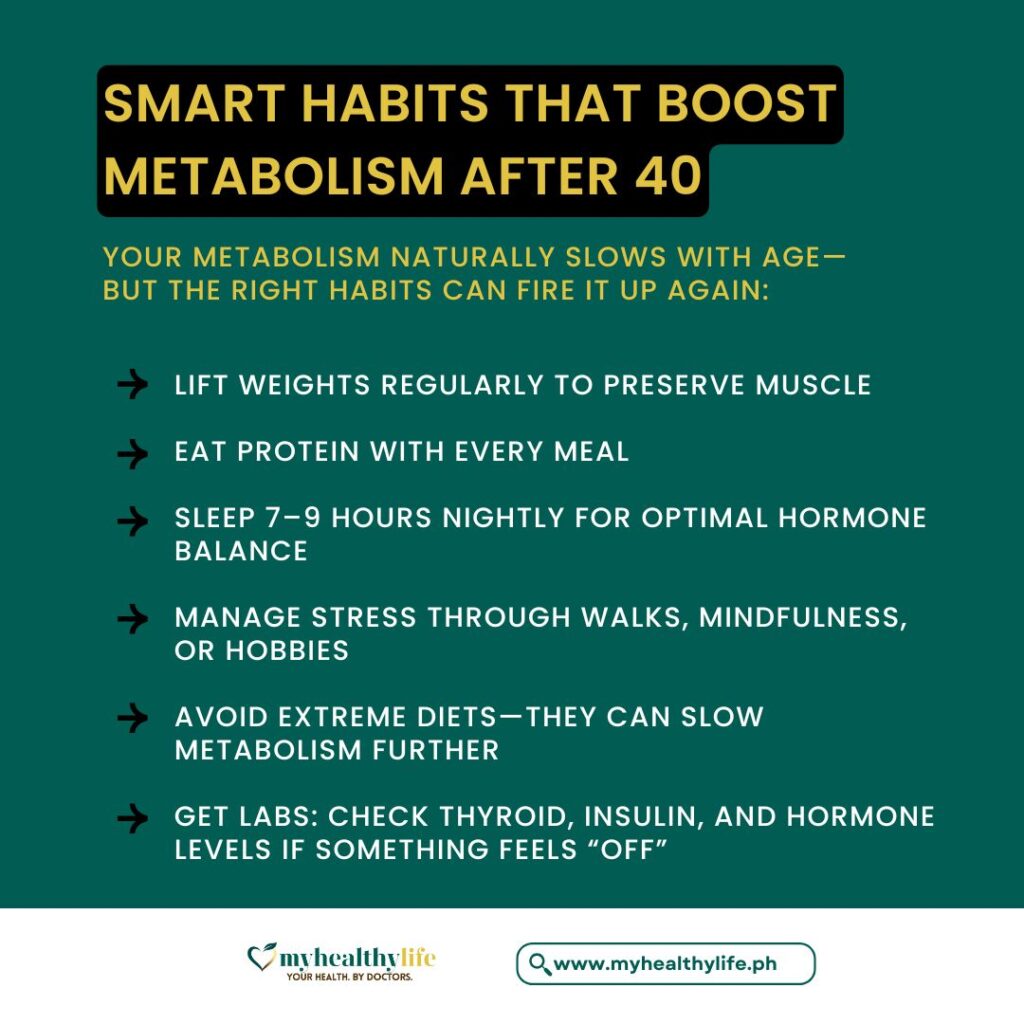
Smart Habits That Boost Metabolism After 40
- Lift weights to preserve muscle
- Eat protein with every meal
- Sleep 7–9 hours nightly
- Manage stress through walks, mindfulness, or hobbies
- Avoid extreme diets—they slow metabolism more
- Test thyroid, insulin, and sex hormones if you feel “off”
Let's Flip the Script on the Age Excuse
Here’s the truth:
Metabolism doesn’t suddenly fall off a cliff at 40. But if you treat your body the same way you did at 25, it can feel like it.
💬 Think of this decade as a chance to recalibrate, not retreat.
It’s not about perfect discipline or obsessing over numbers.
It’s about understanding what your body needs now—and showing up for it with smarter habits, stronger routines, and more self-awareness.
Closing Challenge: Are You Fueling or Slowing Your Metabolism?
Take 60 seconds to reflect:
- Do you lift weights at least once a week?
- Are you eating enough protein?
- When was your last full hormone panel or thyroid test?
- Have you been relying more on cardio than resistance?
- Do you sleep at least 7 hours most nights?
If you said “no” to 2 or more, it’s not too late to course correct. Your 40s and 50s can be your most energized, strongest years yet.
Because your body’s not giving up on you—it’s just asking for better support. 🙌
Share:
Related Posts

How Thyroid Issues Hide Behind Common Symptoms

How Hormones Affect Men’s Mood More Than We Admit