

You squat down and—click—your knee talks back. You rotate your shoulder—pop.
If your joints are making more noise than your playlist, you’re probably wondering:
“Is this normal… or is something wrong?”
Good question. Clicking joints, or what doctors call crepitus, are super common. In many cases, it’s harmless. But sometimes, that sound is your body waving a red flag—especially when pain or swelling is involved.
Let’s break it down.
Why Joints Click, Pop, or Crack
There are several normal reasons joints make noise:
1. Gas Bubbles
Your joints contain synovial fluid, which lubricates movement. Sometimes, bubbles of gas form and pop as you move—like cracking your knuckles.
✅ Totally harmless.
2. Tendons Snapping Over Bones
Tendons glide over bones and sometimes shift slightly out of place before snapping back into position—creating a clicking or snapping sound.
✅ Usually harmless if not painful.
3. Ligament or Muscle Tightness
When muscles or ligaments are tight, movement can create friction and sound.
✅ Common in people with poor flexibility or those who are sedentary.
When Clicking Is a Red Flag
But clicking can also signal deeper issues—especially when paired with pain, swelling, or instability.
Here’s when to dig deeper:
1. Knee Clicking with Pain or Swelling
- May signal cartilage wear or arthritis in the knee
- Can result from meniscus damage or patellofemoral syndrome
- Common in athletes or those with past knee injuries
If your knee pain worsens with stairs or squatting—or feels unstable—get it checked.
2. Clicking in Shoulders or Hips with Limited Motion
This may point to:
- Labral tears (hip or shoulder)
- Joint impingement or early arthritis
You’ll likely notice a “catching” or “locking” feeling too.
3. Clicking with Swollen or Stiff Joints
This is where arthritis comes into the picture.
Two common culprits:
- Osteoarthritis – Cartilage wears down, causing rough joint surfaces to grind and click.
- Rheumatoid arthritis – Inflammatory damage leads to joint instability and sounds.
In these cases, clicking is accompanied by stiffness, swelling, or deep aches.
Quick Tip: What Does Clicking Sound Like?
Sound | Likely Cause |
Loud pop when stretching | Gas bubble release – usually harmless |
Repetitive snapping during movement | Tight tendon or muscle imbalance |
Grinding/clicking with pain | Cartilage wear or arthritis – needs evaluation |
Clicking with joint giving way | Ligament issue or instability – see a specialist |
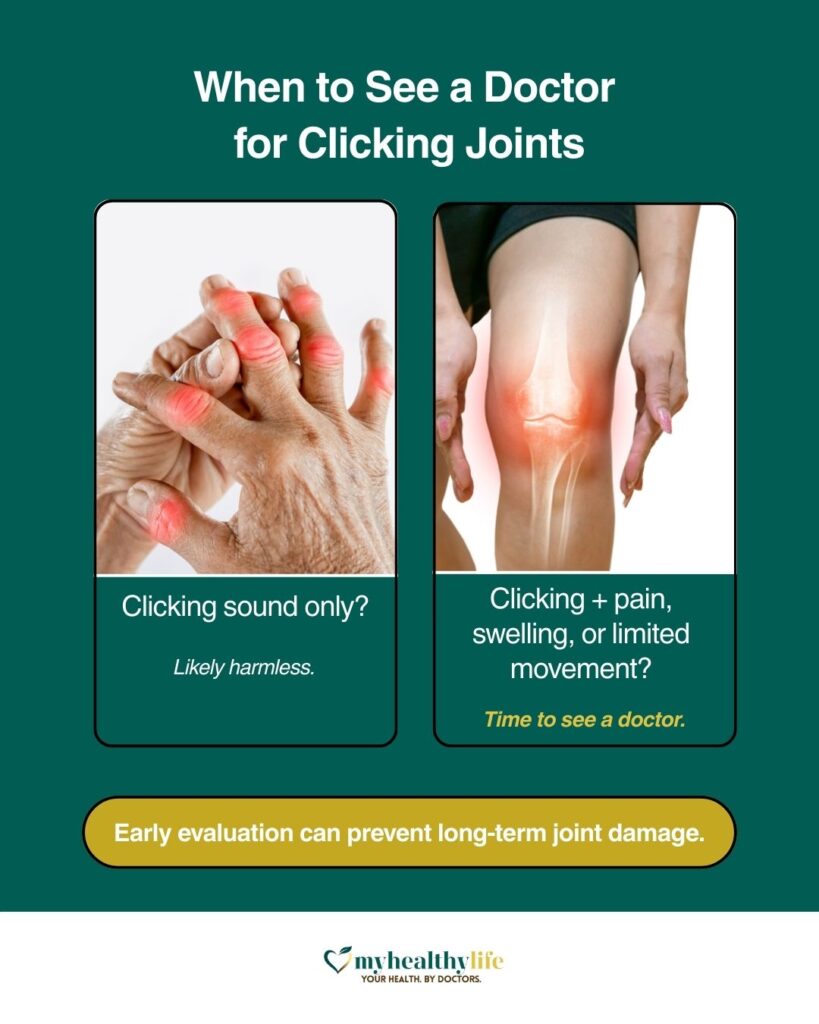
Clicking joints alone? Probably nothing.
Clicking plus pain, swelling, or movement issues? Book that check-up.
Ask your doctor about:
- X-rays (for joint space narrowing, bone spurs)
- MRI (for soft tissue issues like labral or meniscus tears)
- Physical therapy if imbalance or weakness is contributing
What You Can Do at Home
If your clicking isn’t tied to pain or swelling, these self-care tips can help:
- Strengthen the muscles around your joints (especially the quads, glutes, and shoulders)
- Stretch regularly to reduce tightness
- Use anti-inflammatory foods like fatty fish, turmeric, or leafy greens
- Stay hydrated – synovial fluid needs water to work well
- Avoid repetitive stress or poor posture that overloads the joints
If you have arthritis, your doctor might suggest:
- NSAIDs or joint injections
- Low-impact exercise (like cycling, swimming, or tai chi)
- Supportive footwear or braces
QUIZ TIME: “Is Your Joint Clicking Normal?”
Test yourself with this 3-question check-in. Keep score below!
- Does your clicking happen…
A. Only when stretching or after sitting too long
B. Every time you move a joint during daily tasks
C. With pain, swelling, or joint weakness - Do your joints feel…
A. Fine—no pain at all
B. Occasionally sore, especially with activity
C. Stiff or swollen regularly, especially in the morning - Your reaction to the noise is…
A. I laugh it off.
B. I’m starting to get concerned.
C. I avoid certain movements because it hurts.
YOUR SCORE:
- ✅ Mostly A’s – Totally normal. You’re just noisy.
- ⚠️ Mostly B’s – Keep an eye on it. Try stretches and strength work.
- 🚨 Mostly C’s – Time for a doctor’s opinion.
If your body’s making noise, don’t panic—but don’t ignore it either.
Stay in tune with what your joints are telling you—and take action if the sound turns into a symptom.
Need reliable info for every joint, muscle, and mystery pain?
Follow MyHealthyLife—your go-to source for simple, science-backed advice that keeps your body moving strong.
Share:
Related Posts

Why Your Back Pain Keeps Coming Back—Despite Rest

When Your Doctor Orders a Bone Scan: What to Expect