If your doctor says, “Let’s schedule a bone scan,” you might be thinking—
Do I have osteoporosis? Do I have weak bones? Am I at risk of fractures?
Don’t worry. A bone scan isn’t something to fear—it’s a powerful, painless way to detect early signs of bone loss or hidden issues before they turn serious.
Whether you’ve had recurring back pain, are entering menopause, or simply want to check your bone strength, this guide will walk you through what a bone scan is, why it’s done, and what the results really mean for your health.
What Is a Bone Scan, Exactly?
There are actually two types of bone scans used in the Philippines, and they serve different purposes:
1. DEXA (Dual-Energy X-ray Absorptiometry)
Also known as a bone density scan, this is the most common test used to check for osteoporosis or low bone mass.
✅ Measures how dense your bones are
✅ Usually done on your hip and lower spine
✅ Completely painless and non-invasive
2. Bone Scintigraphy (Bone Scan with Tracer Injection)
This one is different. It uses a tiny amount of radioactive material to detect abnormal bone activity.
✅ Used for detecting fractures, bone infections, or tumors
✅ Especially helpful when the cause of pain isn’t showing on X-rays or MRIs
✅ Requires a small injection and a scanner that detects how your bones absorb the tracer
Who Usually Needs a Bone Scan?
Doctors recommend bone scans when:
- You’re over 50, especially post-menopause
- You’ve experienced a fracture from a mild fall
- You’ve had chronic bone pain without a clear cause
- You’re taking medications (like steroids) that can weaken bones
- You have a family history of osteoporosis
- You have chronic conditions like rheumatoid arthritis or thyroid problems
Bone scans are also valuable if you’ve had low calcium or vitamin D3 levels—nutrients that are critical for bone health.
What Happens During the Procedure?
✅ For a DEXA scan:
- You’ll lie down fully clothed (no metal buttons/zippers).
- The scanner moves over your lower spine and hips.
- The scan takes 10–15 minutes, and you can go home immediately.
✅ For a bone scintigraphy:
- You’ll be injected with a small radioactive tracer (it’s safe and painless).
- You’ll wait a few hours for it to circulate.
- The scan itself takes about 30–60 minutes.
- You’ll lie still while a scanner captures images of your entire skeleton.
💡 Tip: Drink water before and after a scintigraphy to flush out any unused tracer.
What Do the Results Mean?
DEXA Scan Results:
Your result comes as a T-score:
- -1.0 or above = Normal
- -1.1 to -2.4 = Osteopenia (mild bone loss)
- -2.5 or below = Osteoporosis
If you fall in the osteopenia or osteoporosis range, your doctor may recommend:
- Vitamin D3 supplements
- Calcium-rich foods or supplements (e.g., calciumade mg)
- Weight-bearing exercises (like walking or light strength training)
- Medication to slow bone loss
Bone Scintigraphy Results:
Your bones absorb the tracer differently based on activity. “Hot spots” may indicate:
- Fractures
- Infections
- Bone cancer
- Degenerative changes like arthritis
These are often followed up with an MRI or biopsy for confirmation.
How Often Should You Get a Bone Scan?
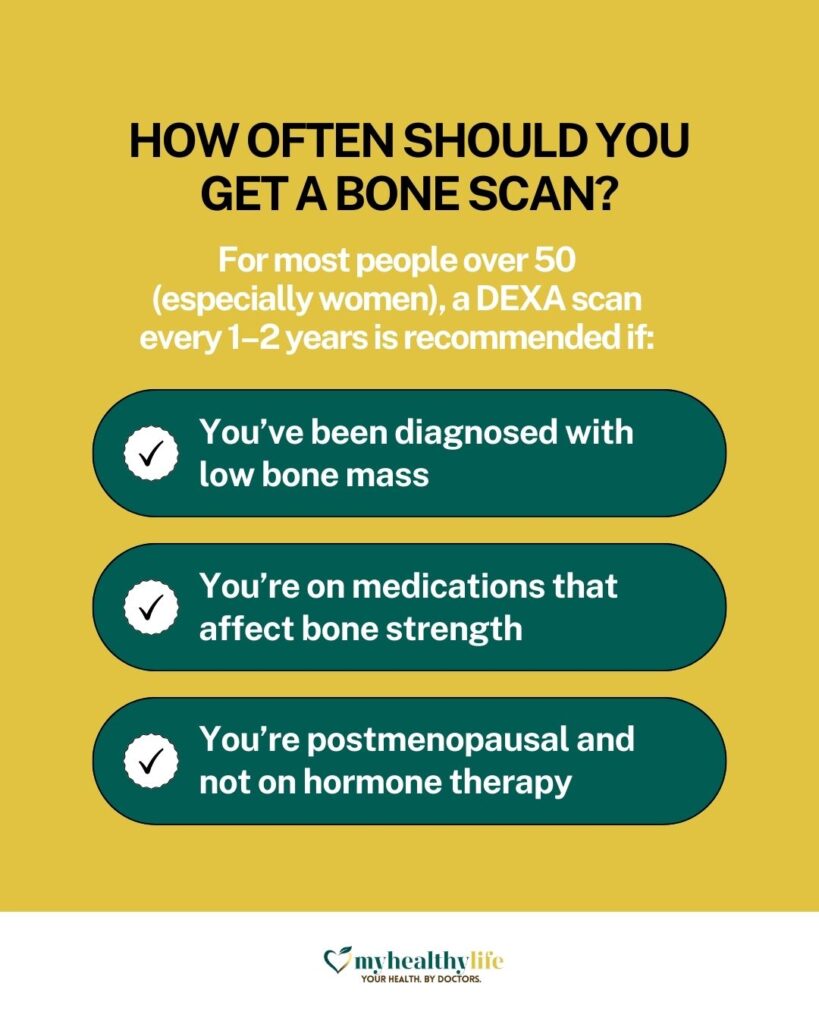
For most people over 50 (especially women), a DEXA scan every 1–2 years is recommended if:
- You’ve been diagnosed with low bone mass
- You’re on medications that affect bone strength
- You’re postmenopausal and not on hormone therapy
Even younger adults may be tested if they have risk factors or unexplained bone pain.
Reflection Prompt: Know Your Risk, Own Your Health
Take a minute to reflect:
- Have you experienced a sudden fracture from a simple fall?
- Do you have a parent or grandparent who suffered from osteoporosis?
- Are you getting enough calcium and vitamin D3 daily?
- Do you feel persistent bone or back pain that hasn’t been explained?
If even one answer gives you pause, consider talking to your doctor about a bone scan.
You can’t fix what you don’t know—but with the right tests, you can protect your bones for the long haul.
Want more clarity on bone health, joint pain, or muscle strength?
Stick with MyHealthyLife – your go-to source for medically sound, easy-to-digest guidance on everyday health 🦴.
Because strong bones and smarter choices go hand in hand.
Share:
Related Posts
Why Your Back Pain Keeps Coming Back—Despite Rest
When to Start Screening for Osteoporosis