When your breathing suddenly feels heavy, every second counts. For some, the first instinct is to grab the nebulizer and let the mist work its magic. For others, it’s to pop an antihistamine and hope the swelling or allergic reaction settles. But which one truly works faster—and more importantly, which one is the right choice for your situation?
The answer isn’t as straightforward as picking the quickest fix. Nebulizers and antihistamines work in fundamentally different ways. One directly targets the airways, the other calms an overactive immune response. Understanding when to use each could mean the difference between fast relief and a prolonged struggle to breathe.
Understanding How Each Works
Before deciding which is faster, it’s important to know what each treatment is designed to do.
The Asthma Nebulizer
An asthma nebulizer delivers medication—often a bronchodilator like salbutamol—directly into the lungs in a fine mist. This helps relax the muscles around your airways, allowing them to open up and make breathing easier.
When it’s used:
- Acute asthma attacks
- Chronic obstructive pulmonary disease (COPD) flare-ups
- Bronchial asthma episodes triggered by infection, exercise, or allergens
How fast it works:
For most bronchodilators delivered via nebulizer, relief can begin within 5–15 minutes. This makes it ideal for situations where airways are tight and oxygen levels are dropping.
The Antihistamine
An antihistamine blocks the effects of histamine—a chemical your body releases during allergic reactions. Histamine causes swelling, itching, and mucus production in the nose, throat, and lungs.
When it’s used:
- Seasonal allergies (hay fever)
- Allergic rhinitis
- Mild allergic asthma symptoms
- Hives or skin swelling that may affect breathing
How fast it works:
Oral antihistamines can take anywhere from 15 minutes to 1 hour to show noticeable effects. Faster-acting options like liquid formulations or certain newer-generation tablets may start working within 15–30 minutes.
Which One Works Faster?
If we’re talking purely about speed, nebulizers usually win when the cause of breathing trouble is airway constriction, such as during an asthma attack. That’s because the medication is inhaled directly where it’s needed—your lungs—bypassing the digestion and absorption process that oral medications must go through.
However, if your breathing trouble is due to swelling from an allergic reaction—especially in the upper airway—an antihistamine might be more effective in the long run. In some cases, doctors will recommend using both, depending on the underlying cause.
Matching the Treatment to the Cause
Speed is important, but accuracy is life-saving. Using the wrong option could delay recovery or even worsen symptoms.
Symptom/Trigger | Better Option | Why |
Sudden wheezing, chest tightness, history of asthma | Nebulizer | Opens constricted airways quickly |
Sneezing, itchy eyes, nasal congestion | Antihistamine | Blocks histamine to reduce allergic symptoms |
Allergic reaction with mild throat swelling | Antihistamine (may need medical help) | Calms immune response |
Shortness of breath after exercise | Nebulizer (if diagnosed with exercise-induced asthma) | Relaxes airway muscles |
Cough from post-nasal drip | Antihistamine | Reduces mucus production |
When You Might Need Both
In some scenarios—like allergic asthma—both treatments may be necessary. The nebulizer can provide rapid relief by opening the airways, while the antihistamine works to prevent further swelling and mucus production.
For example:
- A person allergic to dust might have an asthma flare-up after exposure.
- The nebulizer quickly eases wheezing.
The antihistamine prevents the allergic reaction from worsening.
Common Misconceptions
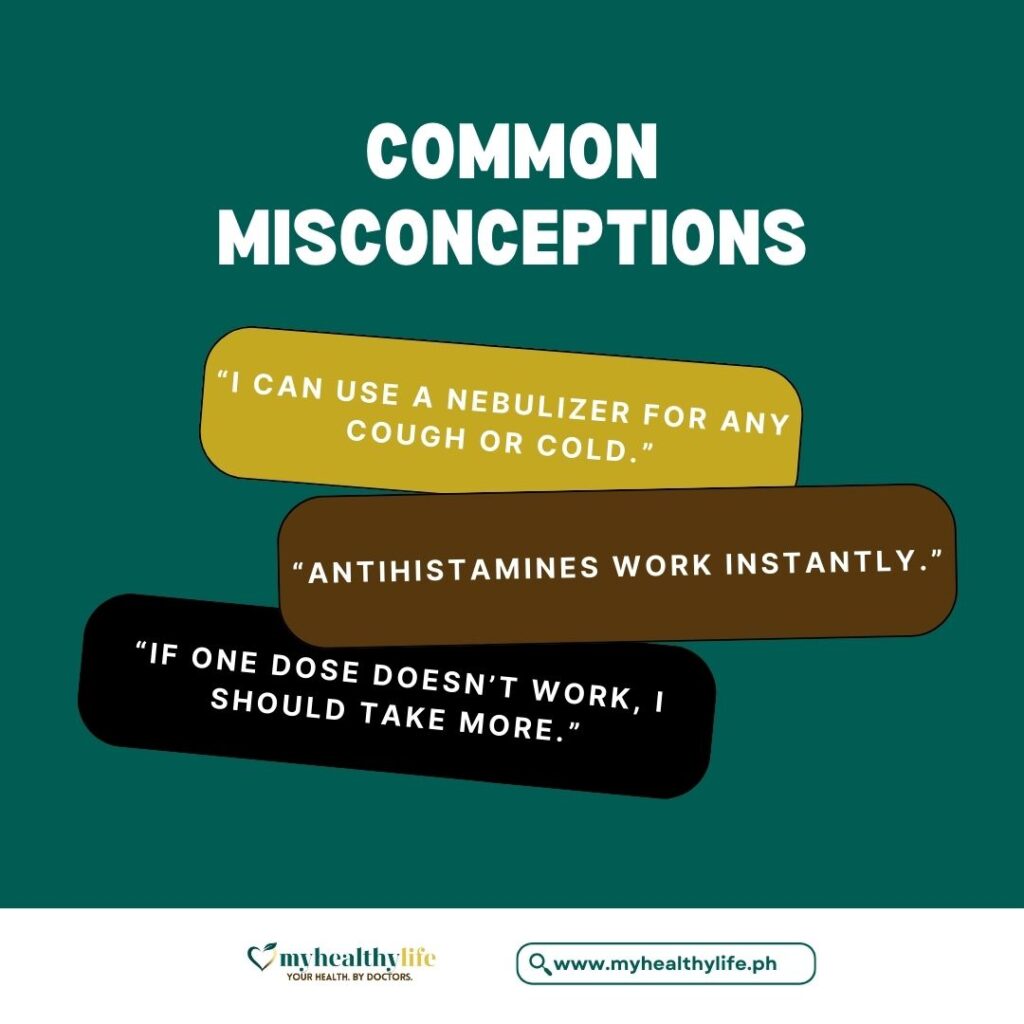
“I can use a nebulizer for any cough or cold.”
Not necessarily. If the cough is from a viral infection without airway constriction, a nebulizer won’t address the root cause.
“Antihistamines work instantly.”
They don’t. Even the fastest-acting ones need at least several minutes to take effect, and they’re more preventive than immediate in some allergic situations.
“If one dose doesn’t work, I should take more.”
Doubling up on medication without medical advice can be dangerous. Overusing bronchodilators can cause rapid heart rate and tremors; excessive antihistamines can cause drowsiness, confusion, or heart rhythm issues.
Safe Use Tips
Nebulizer
- Use only as prescribed by your doctor.
- Clean and disinfect the device regularly to prevent infections.
- Follow the correct dosage—more isn’t always better.
Antihistamine
- Choose the right type for your symptoms (non-drowsy vs. sedating).
- Avoid mixing with alcohol or other sedating drugs unless approved.
For severe allergic reactions with breathing difficulty, seek emergency care immediately—antihistamines alone may not be enough.
When to Seek Medical Help Immediately
Regardless of which option you choose first, there are red flags that require urgent care:
- Breathing difficulty that worsens or doesn’t improve within 15–20 minutes after nebulizer use
- Swelling of the lips, tongue, or throat
- Chest pain with shortness of breath
- Oxygen saturation below 90% on a pulse oximeter
- Dizziness or confusion alongside breathing trouble
These could signal a severe asthma attack, anaphylaxis, or a serious lung condition that needs hospital-level intervention.
The Bottom Line? Not Quite—Here’s Your “Breathe Smart” Action Plan
Rather than leaving you with a generic takeaway, let’s make this practical. If you often face breathing trouble, here’s a quick self-check guide to know what to do:
- Identify your main trigger: Asthma flare or allergy?
- Check your toolkit: Do you have both a prescribed inhaler/nebulizer and an appropriate antihistamine at home?
- Act fast: Use the right one immediately based on symptoms.
- Monitor response: Improvement in 15 minutes for nebulizer; 30–60 minutes for antihistamines.
- Don’t hesitate to escalate: If in doubt, call your doctor or head to the ER.
Being prepared doesn’t just mean having the right medicine—it means knowing exactly when and how to use it. The fastest relief is always the one that matches the problem.
https://www.aaaai.org/tools-for-the-public/conditions-library/asthma/asthma
https://www.mayoclinic.org/diseases-conditions/asthma/in-depth/asthma-treatment/art-20045110
Share:
Related Posts

Does Stress Affect Men’s Immunity More Than They Think?

One Simple Habit to Keep Urban Lungs Healthy