
Living in the city comes with its perks—convenience, career opportunities, endless food spots—but it also comes with an invisible threat: poor air quality. The constant exposure to pollution, vehicle exhaust, and indoor irritants slowly impacts your lung health, often without obvious symptoms until years later.
But here’s the good news: while we can’t escape every particle in the air, there’s one simple habit you can start today to help your lungs stay healthy for the long haul—and it’s free, requires no equipment, and can be done anywhere.
The Urban Lung Challenge
Urban environments, especially in densely populated areas, have higher concentrations of particulate matter (PM2.5 and PM10), nitrogen dioxide, and other harmful pollutants. Prolonged exposure can cause or worsen conditions like asthma, chronic bronchitis, and even heart disease.
The World Health Organization estimates that 99% of the global population breathes air that exceeds recommended pollution limits. For city dwellers, this means our lungs are constantly working overtime just to filter out microscopic invaders.
And pollution isn’t the only culprit. Many urbanites spend 80–90% of their time indoors, where indoor air quality can be even worse due to mold, dust, cleaning chemicals, and inadequate ventilation.
The Habit: Daily Breathing Exercises
You might be expecting a high-tech air purifier or an expensive oxygen therapy session. While those can help, the single most impactful, low-cost action you can take for lung health is practicing daily breathing exercises.
Why breathing exercises?
- They strengthen your respiratory muscles, improving how efficiently your lungs move air.
- They help clear mucus and pollutants from your airways.
- They increase oxygen saturation, supporting better energy and overall health.
- They can even help reduce stress, which indirectly benefits your immune system and lung function.
The Science Behind It
Breathing deeply and intentionally increases lung volumes and helps keep the tiny air sacs in your lungs (alveoli) fully inflated. Over time, this prevents stiffness and scarring that can come from shallow breathing habits, common in sedentary lifestyles.
In fact, studies show that breathing exercises can improve lung capacity and oxygen uptake in as little as 6–8 weeks, even in individuals with chronic respiratory issues. For healthy adults, it’s an excellent preventive measure—especially in polluted cities.
Three Proven Breathing Exercises for Urban Adults
You don’t need to spend an hour meditating to get results. Just 5–10 minutes a day can make a difference.
1. Diaphragmatic (Belly) Breathing
- How to do it:
- Sit or lie down comfortably.
- Place one hand on your chest and the other on your belly.
- Inhale deeply through your nose, letting your belly rise (not your chest).
- Exhale slowly through pursed lips.
- Sit or lie down comfortably.
- Why it works: Strengthens the diaphragm, improves oxygen exchange, and promotes relaxation.
2. Pursed-Lip Breathing
- How to do it:
- Inhale slowly through your nose for 2 seconds.
- Purse your lips (like you’re about to whistle) and exhale slowly for 4 seconds.
- Inhale slowly through your nose for 2 seconds.
- Why it works: Keeps airways open longer, making it easier to expel trapped air and pollutants.
3. Box Breathing (Great for Stress & Lung Control)
- How to do it:
- Inhale through your nose for 4 counts.
- Hold your breath for 4 counts.
- Exhale through your mouth for 4 counts.
- Hold again for 4 counts.
- Inhale through your nose for 4 counts.
Why it works: Improves lung capacity and helps regulate breathing under stress, useful for busy city living.
Beyond Breathing: Supporting Your Lungs in the City
While breathing exercises are powerful, combining them with other daily habits amplifies the benefits.
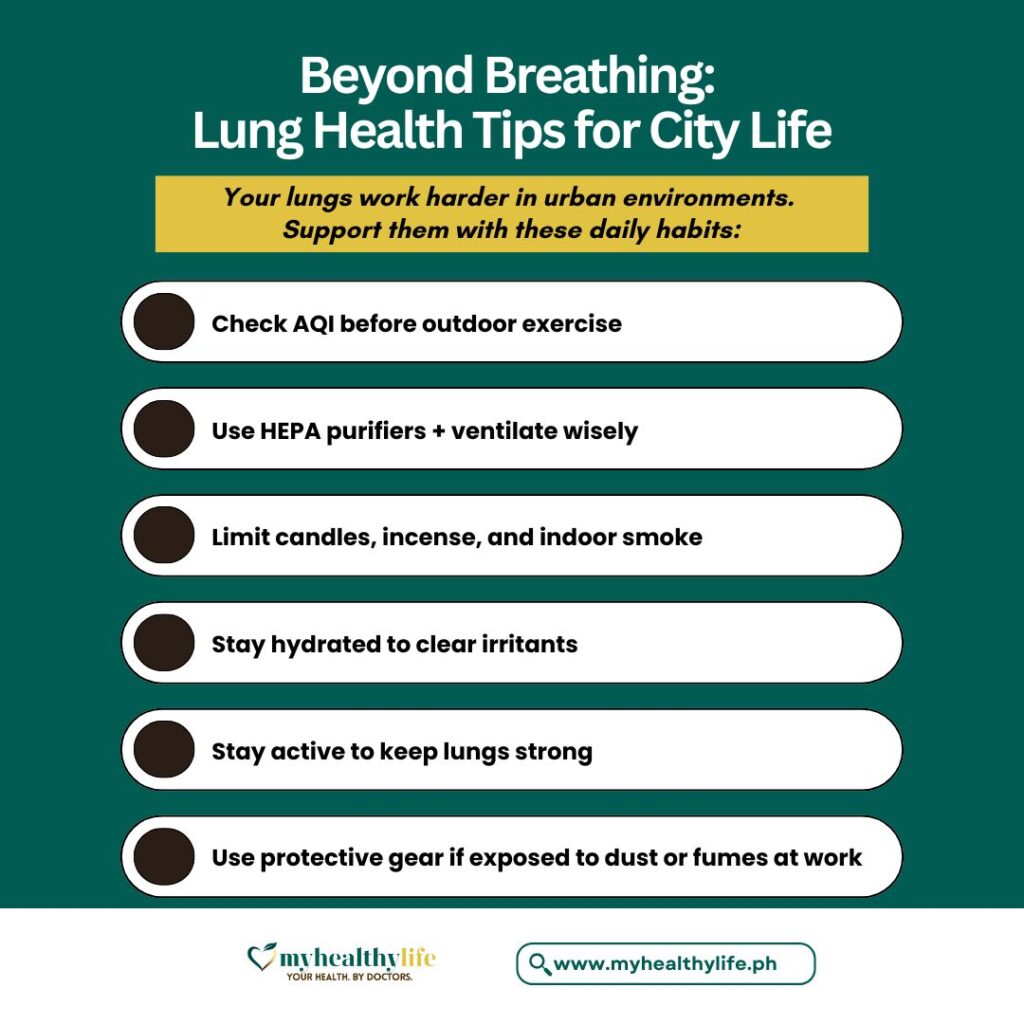
1. Monitor Air Quality Daily
Use apps or websites to check Air Quality Index (AQI) before outdoor activities. If AQI is high, avoid exercising outdoors and keep windows closed.
2. Invest in Indoor Air Quality
- Use a HEPA air purifier for your bedroom or main living space.
- Ventilate your home daily—but only when outdoor air quality is good.
- Avoid burning candles or incense frequently.
3. Stay Hydrated
Drinking enough water helps keep mucous membranes moist, making it easier for your lungs to trap and expel irritants.
4. Stay Active
Aerobic exercises like walking, swimming, or cycling keep your respiratory system strong and efficient.
5. Protect Against Occupational Hazards
If your work exposes you to dust, fumes, or chemicals, always wear protective masks and undergo regular spirometry tests to monitor lung health.
Even with healthy habits, it’s important to get evaluated if you notice:
- Persistent cough lasting more than 8 weeks
- Wheezing or noisy breathing
- Shortness of breath during routine activities
- Chest pain or tightness
- Recurrent respiratory infections
Early detection of lung problems can prevent irreversible damage and improve long-term outcomes.
The Takeaway
Urban living doesn’t have to mean compromised lung health. Daily breathing exercises are the one habit every city adult should adopt—not just for stronger lungs, but for better energy, stress control, and overall well-being. Pair this with mindful indoor air management, hydration, and regular activity, and your lungs will thank you for decades to come.
So tomorrow morning, before you check your phone or dive into work, take five minutes to breathe intentionally. In the grand scheme of urban wellness, it’s a small habit with life-changing potential.
https://www.who.int/news-room/fact-sheets/detail/air-pollution
https://www.lung.org/lung-health-diseases/wellness/breathing-exercises
Share:
Related Posts

Does Stress Affect Men’s Immunity More Than They Think?

Nighttime Chest Tightness: What Your Breathing Is Telling You